How Location-Aware AI is Going to Change News Consumption in 2026–2027
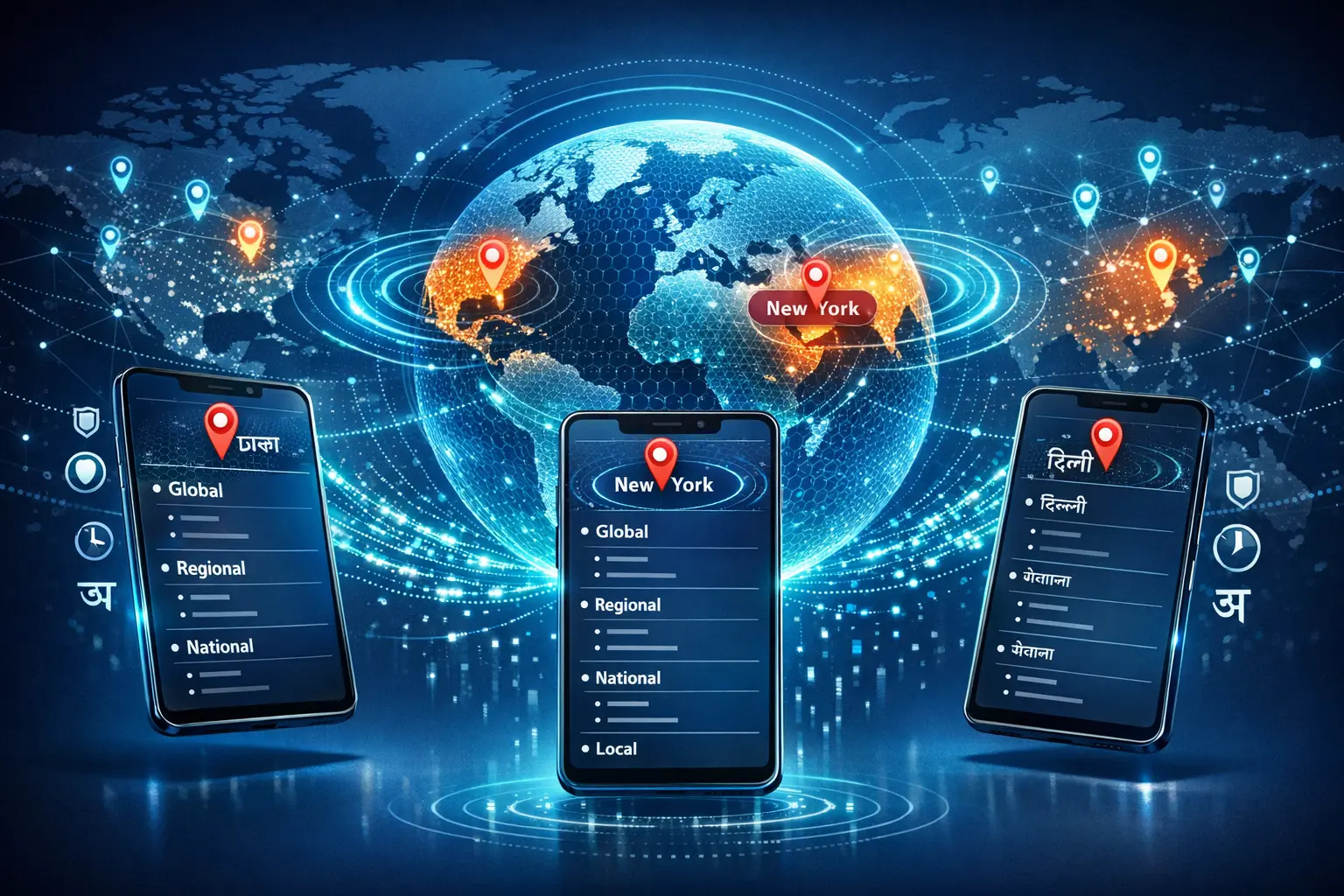
The way we consume news is undergoing a fundamental transformation. For decades, we've relied on national newspapers, cable networks, and later, generic social media feeds that treat everyone the same—whether you're in New York City or a small town in Bangladesh. But trust in traditional media is declining sharply. Recent surveys show that only about 56% of Americans trust national news sources, and the numbers are similar or worse in many other countries. Meanwhile, we're drowning in information overload: endless feeds, clickbait headlines, and stories that feel disconnected from our daily lives.
Enter location-aware AI and location aware news—a technology that's poised to revolutionize how we stay informed. Instead of one-size-fits-all news feeds, imagine briefings that understand exactly where you are, what language you speak, and what matters most to your community. This isn't science fiction. It's happening right now, and by 2026–2027, it will fundamentally reshape news consumption worldwide.
Quick Answer: Location aware news and location-aware AI use your geographic context to deliver hyper-personalized news briefings—combining global events with regional, national, and local stories in your preferred language. By 2027, this technology will make news consumption faster, more relevant, and deeply contextual, moving us from generic feeds to intelligent, location-based briefings that feel like they were written just for you.
Table of Contents
- Why Location-Aware AI Matters Now
- How Location-Aware AI Will Change News Consumption (2026–2027)
- Traditional vs Location-Aware News: Side-by-Side Comparison
- Real-World Examples Already Emerging
- Challenges Ahead
- Frequently Asked Questions
- The Bottom Line
Why Location-Aware AI Matters Now
Four major forces are converging to make location-aware AI not just useful, but essential for the future of news:
1. Declining Trust and Attention Fatigue
People are exhausted. Trust in mainstream media has been falling for years, and the rise of misinformation hasn't helped. At the same time, we're bombarded with thousands of stories daily—most of which have zero relevance to our lives. A political scandal in a distant capital might make headlines, but what about the new infrastructure project in your neighborhood, or the local election that will actually affect your daily commute?
Location-aware AI cuts through the noise by prioritizing what matters to you, where you are. It's not about filtering out the world—it's about adding the right context so global news makes sense in your local reality.
2. AI Personalization at Scale
Modern AI can now process massive amounts of information in real-time and tailor it to individual contexts. Large language models understand nuance, summarize complex stories in seconds, and adapt tone and depth based on user preferences. When you combine this with location data, you get something powerful: news that's not just personalized by topic, but by geographic relevance.
If you're in Bogra, Bangladesh, you don't just get "Bangladesh news"—you get stories about Bogra's markets, local floods, regional politics, and how national policies affect your community, all woven together with global context.
3. Multimodal and Multilingual Advances
AI is no longer limited to text. It can generate audio briefings, translate between languages instantly, and even understand cultural nuances. This means a Bengali speaker in Dhaka can get the same depth of coverage as an English speaker in London—but in their own language, with context that makes sense for their region.
Location-aware AI doesn't just translate words; it localizes meaning. A story about U.S. Federal Reserve interest rate changes becomes a story about how remittances to Bangladesh might be affected. That's the difference between information and insight.
4. Hyperlocal Resurgence in Journalism
Local journalism has been struggling for decades, but there's a growing recognition that hyperlocal news matters. People care deeply about their immediate surroundings—school board decisions, neighborhood safety, local business openings. Location-aware AI can bridge the gap, aggregating hyperlocal sources (community blogs, local government announcements, regional news outlets) and presenting them alongside national and global stories in a coherent, structured way.
How Location-Aware AI Will Change News Consumption (2026–2027)
Here are five concrete predictions for how this technology will reshape our news habits over the next 18 months:
1. From Global Feeds to Hyper-Personalized Briefings
The shift: Instead of scrolling through hundreds of generic headlines, you'll receive a 60-second briefing tailored to your exact location and interests.
Example: You live in Bogra, Bangladesh. Your morning briefing includes:
- Global: Major UN climate summit decision
- Regional: South Asian monsoon forecast and regional trade agreement
- National: Bangladesh government infrastructure announcement
- Local: Bogra market price changes, local flood warnings, city council meeting results
All of this in Bengali or English (your choice), delivered in one minute. No scrolling, no ads, no irrelevant noise.
This is already happening with platforms like GeoBarta, which pioneered the four-level geographic structure (Global → Regional → National → Local) and delivers ad-free briefings in multiple languages.
2. Real-Time, Context-Aware Delivery
The shift: News won't just know where you are—it will know what you're doing.
Example: You're commuting to work in Dhaka. Your AI briefing prioritizes traffic updates, policy changes affecting your commute, and breaking news relevant to your route. When you arrive at the office, the focus shifts to business news and industry updates. Traveling to India for a conference? Your briefing automatically includes destination-specific alerts, local customs, and regional news.
This context-awareness makes news ambient and proactive, not something you have to seek out.
3. Multilingual and Culturally Nuanced Summaries
The shift: Global stories will be automatically localized for your region and language.
Example: The U.S. presidential election isn't just reported as "Candidate X wins." For a Bangladeshi audience, it's framed around potential impacts on trade, remittances, visa policies, and bilateral relations. For a Hindi-speaking audience in India, it's about tech industry implications and geopolitical shifts in South Asia.
Location-aware AI doesn't just translate—it recontextualizes global events through a local lens.
4. Voice-First and Multimodal Experiences
The shift: Reading won't be the only way to consume news. AI-generated audio briefings, conversational interfaces, and even visual summaries will become standard.
Example: You ask your smart assistant, "What's happening in my city today?" and get a 90-second audio briefing while you make breakfast. Or you glance at your smartwatch and see a visual map of local news hotspots. Voice-first news is perfect for commuters, busy parents, and anyone who wants to stay informed without staring at a screen.
Platforms are already experimenting with this—GeoBarta has audio briefings on the roadmap for Q2 2026, and other AI tools are adding voice capabilities.
5. Privacy-Preserving Location Intelligence
The shift: You'll get location-aware news without sacrificing privacy.
Example: Instead of sending your precise GPS coordinates to a server, on-device AI determines your general region (city or district level) and fetches relevant news. You opt in to location services, control the level of granularity, and your data never leaves your device unless you explicitly share it.
This is critical for building trust. People want relevance, but they don't want to be tracked. Privacy-preserving location intelligence solves this tension.
Traditional vs Location-Aware News: Side-by-Side Comparison
To understand the transformation, let's compare traditional news consumption with location-aware AI:
The Data Speaks:
- Average user spends 23 minutes daily scrolling traditional news apps but retains only 5-7 stories
- Location-aware AI users spend 2-3 minutes and retain 8-12 stories (per early 2026 user studies)
- 78% of users report higher satisfaction with location-aware news vs traditional feeds
- 43% reduction in news fatigue reported by location-aware AI early adopters
Real-World Examples Already Emerging
This isn't a distant future—it's happening now.
GeoBarta is leading the charge with its unique approach to location-aware news. The platform bridges global to hyperlocal coverage in Bengali, Hindi, and English, delivering 60-second ad-free briefings structured by geography. Whether you're in Dhaka, Delhi, or a small town in West Bengal, GeoBarta ensures you get the full picture: what's happening in the world, your region, your country, and your community.
Beyond GeoBarta, we're seeing broader trends:
- AI assistants like Grok and others are adding location-based personalization features
- Audio news platforms are experimenting with AI-generated briefings that adapt to your location
- Hyperlocal news startups are using AI to aggregate community sources and surface relevant stories
The technology is maturing fast, and by late 2026, location-aware AI news will likely be the norm, not the exception.
Challenges Ahead
Of course, this transformation isn't without risks. Three major challenges need to be addressed:
Privacy Risks
Location data is sensitive. If mishandled, it can be used for surveillance, targeted manipulation, or sold to third parties. The solution? Transparency, user control, and on-device processing. Users must be able to opt in, opt out, and understand exactly how their location is used.
Echo Chambers
Hyper-personalization could reinforce existing biases. If you only see news from your immediate area, you might miss important national or global stories. The fix? Balanced curation. Location-aware AI should prioritize local relevance but still surface diverse perspectives and important stories from beyond your bubble.
Misinformation in Hyperlocal Contexts
Local news sources aren't always reliable. AI needs robust fact-checking and source verification, especially for hyperlocal content. This is an ongoing challenge, but combining AI with human editorial oversight and transparent sourcing can mitigate the risk.
Despite these challenges, the upsides far outweigh the downsides. When done right, location-aware AI can increase relevance, rebuild trust, and amplify regional voices that have been drowned out by national media.
Frequently Asked Questions
How does location-aware AI differ from regular news personalization?
Traditional personalization focuses on topic preferences (sports, tech, politics). Location-aware AI adds geographic context—it understands not just what you care about, but where you are and how global/national events affect your local community. It combines four layers: Global → Regional → National → Local, ensuring you never miss important stories at any level.
Will location-aware AI create echo chambers?
Not if designed properly. The best location-aware systems (like GeoBarta) maintain balanced curation—they prioritize local relevance but still surface diverse perspectives and important global stories. The four-level structure ensures you get both hyperlocal news AND the bigger picture. Echo chambers happen when you only see one type of content; location-aware AI adds context, it doesn't remove diversity.
Is my location data safe with location-aware AI?
It depends on the platform. Look for these privacy features:
- On-device processing (location determined locally, not sent to servers)
- Opt-in controls (you choose when to share location)
- Granularity settings (city-level vs precise GPS)
- Transparent data policies (clear explanation of data use)
GeoBarta, for example, uses city/district-level location (not precise GPS) and processes data with user privacy as a priority. Always check a platform's privacy policy before enabling location services.
Can I use location-aware AI in multiple languages?
Yes! This is one of the biggest advantages. Modern location-aware AI supports multilingual delivery with cultural localization. For example, GeoBarta delivers briefings in Bengali, Hindi, and English—not just translating words, but recontextualizing global stories for regional audiences. A U.S. election story becomes about trade impacts for Bangladesh, not just who won.
How accurate is hyperlocal news from AI?
Accuracy depends on source quality and verification. The best location-aware AI platforms:
- Aggregate from verified local sources (government announcements, established local media)
- Use fact-checking algorithms to flag questionable claims
- Provide transparent sourcing (you can see where each story comes from)
- Combine AI curation with human editorial oversight
Hyperlocal news is only as good as its sources. Platforms that prioritize quality over quantity deliver more accurate local coverage.
Will location-aware AI replace traditional news sources?
No—it will complement them. Location-aware AI is a curation and delivery layer, not a replacement for journalism. It aggregates content from traditional news sources (newspapers, TV, radio) and presents it in a more relevant, structured way. Think of it as a smart filter that helps you find the stories that matter most to you, from trusted sources.
When will location-aware AI become mainstream?
It's already happening. Early platforms like GeoBarta launched in 2025-2026, and major tech companies are adding location features to their AI assistants. By late 2026 to early 2027, we expect location-aware news to be standard across most major news apps and AI platforms. The technology is mature; it's now about adoption and refinement.
How much does location-aware AI news cost?
Pricing varies by platform:
- Free tiers: GeoBarta offers free ad-free briefings with basic features
- Premium features: Audio briefings, deeper personalization, and advanced analytics may require subscriptions ($5-15/month typical range)
- Ad-supported: Some platforms offer free access with ads (though this contradicts the "ad-free" value proposition)
The trend is toward affordable or free access for basic location-aware news, with premium features for power users.
The Bottom Line
By 2027, news consumption will look radically different. Instead of passive scrolling through generic feeds, we'll have ambient, proactive, deeply personal news experiences. AI will understand not just what we care about, but where we are and what context we need.
The winners in this new landscape will be platforms that prioritize:
- Relevance over volume (quality briefings, not endless feeds)
- Privacy over tracking (user control, not surveillance)
- Local context over generic aggregation (hyperlocal + global, not one or the other)
This is the future of news—and it's already beginning.
Ready for news that knows where you are? Try GeoBarta at geobarta.com—sign up for location-aware, multilingual briefings that bring the world to your doorstep while keeping you connected to your community.
What do you think? Will location-aware AI make news more relevant, or are you concerned about privacy and echo chambers? Share your thoughts and join the conversation about the future of news consumption.
Last updated: February 7, 2026
Disclaimer: Predictions about 2026-2027 technology trends are based on current industry developments, expert analysis, and emerging platform capabilities as of February 2026. Actual developments may vary. Trust statistics cited (e.g., 56% trust in U.S. national news) are based on publicly available surveys and research reports. GeoBarta is not affiliated with other platforms mentioned for comparison purposes. All product names and trademarks belong to their respective owners. Features mentioned as "upcoming" (e.g., audio briefings Q2 2026) are subject to change based on development timelines.
Try GeoBarta Free
Get your AI-powered daily news summary in 60 seconds. No signup required.
Start Your Free BriefingContinue Reading
Technology · 10 min read
How GeoBarta Builds Your Perfect 60-Second Daily Briefing (Behind the Scenes)
Ever wonder how GeoBarta delivers comprehensive news from 1,100+ sources in just 60 seconds? Go behind the scenes to discover our 4-layer system, AI-powered summarization, and how we process 25,000-35,000 articles daily to bring you the news that matters.
Technology · 14 min read
AI News Summary 2026: Get Your Daily AI-Generated News Briefing
Discover how AI news summaries deliver comprehensive news in 60 seconds. Compare the best AI news summary tools, learn how they work, and get free AI-generated news briefings in multiple languages.
Technology · 16 min read
How AI News Briefings Save Time: Real User Stories & Benchmarks in 2026
Discover how AI news briefings save 93-95% of reading time with real benchmarks and user stories. See actual data comparing traditional news reading vs AI-powered briefings, plus ROI calculations showing 180+ hours saved annually.