Why Most News Apps Fail at Local News (And How to Fix It in 2026)
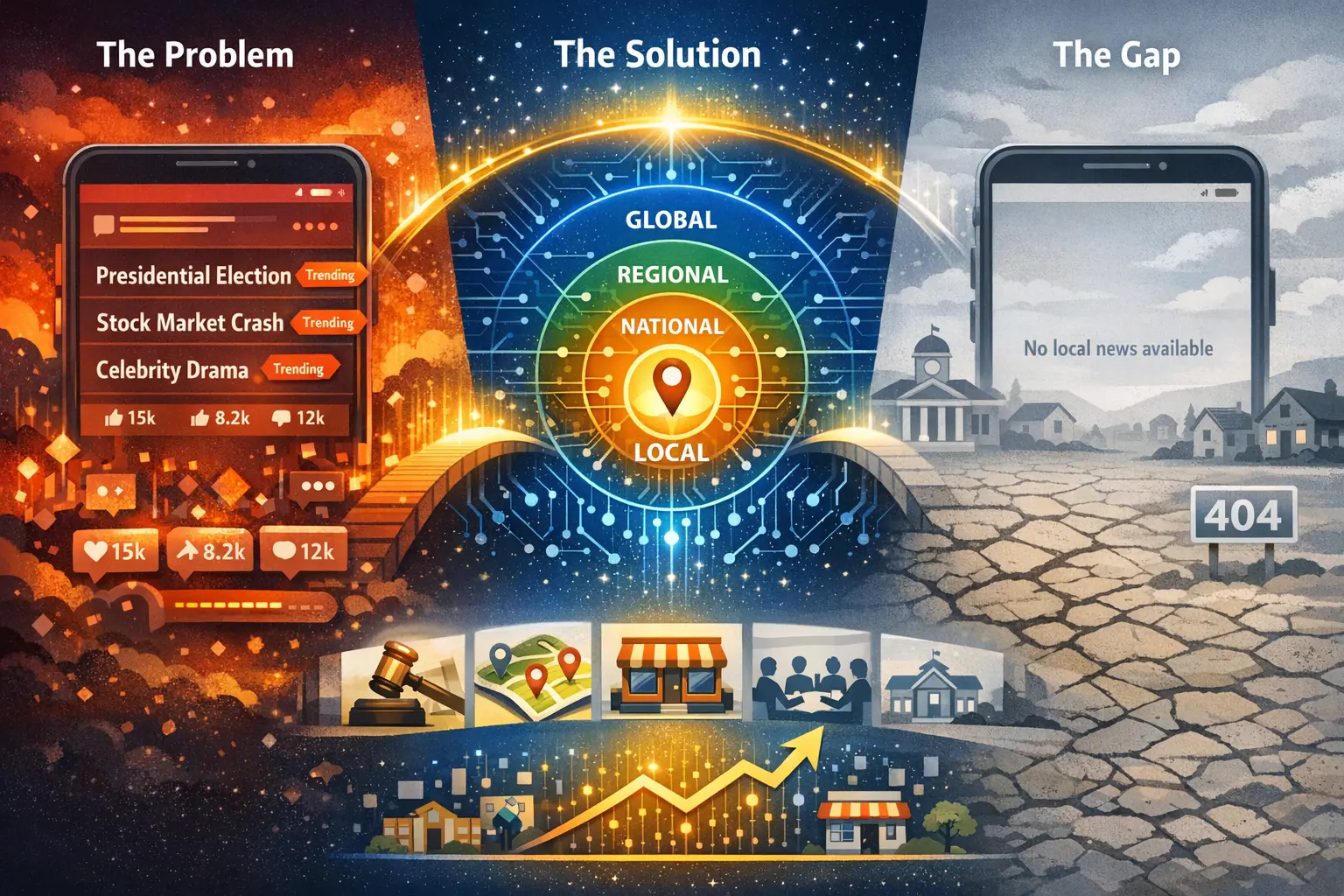
When was the last time your news app told you about a city council decision that affects your property taxes? Or a new business opening in your neighborhood? Or a local school board meeting that impacts your children's education? If you're like most people, the answer is: never.
Here's the uncomfortable truth: While news apps excel at delivering national headlines and global events, they're systematically failing at local news—the news that actually affects your daily life. A 2025 Pew Research study found that 73% of news aggregator apps provide little to no local news coverage, and when they do, it's often outdated or irrelevant.
Quick Answer: Most news apps fail at local news because they prioritize viral national stories over community journalism, lack location-aware technology, and can't monetize local content effectively. The solution: Use location-aware news apps like GeoBarta that organize news from Global → Regional → National → Local, or combine multiple sources including dedicated local news apps, community newsletters, and hyperlocal platforms. This affects communities globally—from US news deserts to declining local newspapers in UK, India, Australia, and Canada.
This isn't just an inconvenience—it's contributing to a crisis in local journalism and creating "news deserts" where communities lack access to critical information about their own neighborhoods.
Table of Contents
- The Local News Crisis: By the Numbers
- Why News Apps Systematically Ignore Local News
- What You're Missing Without Local News
- How News Apps Could Fix Local Coverage
- Best Solutions for Getting Local News in 2026
- The Future: Location-Aware AI News
- How to Build Your Local News Routine
The Local News Crisis: By the Numbers
The decline of local news isn't just about apps—it's a systemic crisis affecting communities worldwide:
United States
- 2,900+ local newspapers have closed since 2005 (Northwestern University, 2024)
- 204 counties (6.4% of all U.S. counties) have become "news deserts" with zero local news outlets
- Half of all counties have only one local news source, usually a weekly newspaper
- 70% of journalism jobs lost between 2008-2020
United Kingdom
- 265 local newspapers closed between 2005-2023
- 50% decline in local news journalists since 2007
- Many communities rely solely on Facebook groups for local information
- Rural areas particularly affected with limited broadband access
Global Impact
- India: Local language newspapers declining despite population growth; 200+ closures in tier-2 and tier-3 cities
- Australia: 170+ local newspapers closed in rural areas since 2019; indigenous communities severely impacted
- Canada: 450+ news outlets closed or merged since 2008; French-language local media particularly affected
- Bangladesh: Growing digital divide limits local news access in rural areas
- Nigeria: Local news infrastructure struggling in non-urban centers
The App Problem
- 73% of news aggregator apps provide minimal or no local news (Pew Research, 2025)
- Google News: Less than 5% of stories are genuinely local
- Apple News: Local section exists but often shows regional/national stories
- Flipboard: Primarily national and international content
- SmartNews: Better local coverage but still limited to major cities
Why News Apps Systematically Ignore Local News
News apps aren't deliberately trying to ignore your community—but their business models, algorithms, and technical limitations create systematic barriers to local coverage.
1. The Algorithm Favors Viral Over Local
The Problem: News app algorithms prioritize engagement metrics—clicks, shares, time spent reading. National and global stories naturally generate more engagement because they have larger potential audiences.
Real Example: A story about a presidential election will get 10 million clicks. A story about your city's new zoning laws might get 5,000. The algorithm learns to prioritize the former.
Why It Matters: This creates a feedback loop where local stories never surface, even to people who would find them highly relevant.
2. Location Technology Isn't Precise Enough
The Problem: Most news apps use crude location detection:
- Country-level: Shows you "U.S. news" but you're in Seattle, not Miami
- State/Province-level: Better, but still too broad
- City-level: Rare, and often inaccurate
- Neighborhood-level: Almost non-existent
Real Example: If you live in Brooklyn, New York, most apps will show you "New York news"—which means Manhattan-centric stories about Wall Street and Broadway, not the school board meeting in your district or the new bike lane on your street.
Technical Challenge: Precise location detection requires:
- GPS permissions (privacy concerns)
- IP address geolocation (inaccurate)
- User-provided location (friction)
- Constant updates as users move
3. Local News Sources Are Fragmented
The Problem: National news comes from a few major sources (AP, Reuters, major newspapers). Local news comes from thousands of small sources:
- Local newspapers (often behind paywalls)
- Community blogs
- City government websites
- Neighborhood Facebook groups
- Local TV station websites
- Community newsletters
Integration Challenge: News apps would need to:
- Identify thousands of local sources
- Negotiate access or scraping permissions
- Parse different formats and structures
- Verify credibility of small outlets
- Update constantly as sources appear/disappear
4. Monetization Is Nearly Impossible
The Problem: News apps make money through:
- Advertising: Requires scale; local stories don't have enough viewers
- Subscriptions: Users won't pay for an app that's mostly national news with some local
- Affiliate links: Don't work for local government or community stories
Economic Reality: A national political story can generate $50-100 in ad revenue. A local zoning story might generate $0.50. The economics simply don't work.
5. Content Quality Varies Wildly
The Problem: National news outlets have professional editors, fact-checkers, and standards. Local news sources range from:
- Professional local newspapers (high quality)
- Community blogs (variable quality)
- Government press releases (dry but accurate)
- Neighborhood Facebook posts (often unreliable)
- Local influencers (mixed credibility)
Risk Management: News apps are risk-averse. Including low-quality local sources could damage their reputation, so they simply exclude most local content.
6. User Behavior Seems to Favor National News
The Problem: When news apps track user behavior, they see:
- Users spend more time on national/global stories
- Users share national stories more frequently
- Users click on sensational headlines over local issues
The Catch-22: But this is partly because:
- Local stories are buried or absent
- Headlines aren't optimized for local relevance
- Users don't know local news is available
- The app never trained users to expect local content
What You're Missing Without Local News
The absence of local news in your daily briefing isn't just an inconvenience—it has real consequences for your life, your community, and democracy itself.
Personal Impact
Financial Decisions:
- Property tax changes that affect your mortgage
- Local business openings/closings that impact your shopping
- Zoning changes that affect your property value
- Local economic development that creates job opportunities
Safety & Health:
- Crime trends in your specific neighborhood
- Local health department alerts
- Road closures and construction projects
- Emergency services changes
Education:
- School board decisions affecting your children
- Local education funding changes
- New programs or curriculum updates
- Teacher hiring/retention issues
Quality of Life:
- New parks, restaurants, or entertainment venues
- Community events and festivals
- Local sports and cultural activities
- Neighborhood improvement projects
Community Impact
Civic Engagement:
- Without local news, voter turnout in local elections drops by 10-15%
- Citizens are less likely to attend city council meetings
- Community organizing becomes more difficult
- Local politicians face less accountability
Social Cohesion:
- Shared local news creates community identity
- Without it, neighborhoods become collections of strangers
- Local heroes and positive stories go unrecognized
- Community problems go unaddressed
Economic Development:
- Local businesses struggle to reach customers
- Economic opportunities go unnoticed
- Investment in communities decreases
- "Brain drain" accelerates as young people leave
Democratic Impact
Accountability Crisis:
- Local corruption goes unreported
- Municipal spending lacks oversight
- Police misconduct isn't investigated
- Environmental violations go unnoticed
Policy Vacuum:
- Important local issues aren't debated
- Citizens can't make informed voting decisions
- Special interests face less scrutiny
- Public participation in governance declines
How News Apps Could Fix Local Coverage
The good news: The technology exists to solve this problem. Here's what news apps need to do:
1. Implement True Location-Aware Technology
Solution: Multi-layer geographic organization
- Global: Major world events
- Regional: Continental/multi-country developments (e.g., Europe, South Asia)
- National: Country-specific news
- Local: City and neighborhood-level stories
Example: GeoBarta uses this exact structure, automatically detecting your location and organizing news accordingly.
Technical Requirements:
- Precise GPS or IP-based location detection
- User-controlled location settings (privacy)
- Dynamic content loading based on location
- Support for multiple locations (home, work, travel)
2. Aggregate Local Sources Intelligently
Solution: AI-powered local source discovery and aggregation
- Automatically identify credible local sources
- Parse different formats (newspapers, blogs, government sites)
- Verify source credibility using multiple signals
- Update source list continuously
Quality Control:
- Fact-checking algorithms
- Source reputation scoring
- User feedback mechanisms
- Editorial oversight for sensitive topics
3. Redesign Algorithms to Value Relevance Over Virality
Solution: Personalized relevance scoring
- Weight local stories higher for affected users
- Consider geographic proximity in ranking
- Balance global importance with local impact
- Allow users to set local news priority
Example Algorithm:
Story Score = (Global Importance × 0.3) + (Local Relevance × 0.5) + (Recency × 0.2)
Where Local Relevance = f(distance, population affected, personal interests)
4. Create Sustainable Business Models
Solution: Hybrid monetization
- Freemium: Basic local news free, premium features paid
- Community Partnerships: Partner with local businesses for sponsorships
- Municipal Funding: Cities pay for citizen information services
- Nonprofit Model: Foundation or grant-funded
Example: Some European cities fund local news apps as public services, like libraries.
5. Use AI to Summarize and Contextualize
Solution: AI-powered local news summarization
- Automatically summarize city council meetings
- Extract key points from government documents
- Translate bureaucratic language into plain English
- Connect local stories to broader trends
Example: "Your city council voted 7-2 to approve a new bike lane on Main Street. This is part of a $2M transportation plan approved last year. Construction starts in May and will take 3 months."
6. Build Community Features
Solution: Interactive local news features
- User-submitted local tips and stories
- Community discussion forums
- Event calendars
- Local business directories
- Neighborhood-specific alerts
Moderation: AI + human moderators to maintain quality and civility.
Best Solutions for Getting Local News in 2026
While we wait for news apps to improve, here are the best ways to get local news right now:
Option 1: Location-Aware News Apps
GeoBarta (Recommended)
- What It Does: AI-powered news organized in 4 geographic layers (Global → Regional → National → Local)
- Local Coverage: Automatically detects your location and includes city-specific news
- Languages: Bengali, Hindi, English (more coming)
- Cost: Free, no ads
- Best For: Quick daily briefings with local context
- Limitation: Web-only (mobile apps coming Q1 2026)
Google News
- What It Does: Personalized news feed with local section
- Local Coverage: City-level, but often shows regional stories
- Cost: Free
- Best For: Comprehensive coverage if you have time to scroll
- Limitation: Local section is hit-or-miss; algorithm favors national news
Apple News
- What It Does: Curated news with local section
- Local Coverage: Limited to major U.S. cities
- Cost: Free (Apple News+ is $12.99/month)
- Best For: iOS users in major cities
- Limitation: iOS-only; weak international local coverage
Option 2: Dedicated Local News Apps
Nextdoor
- What It Does: Hyperlocal social network for neighborhoods
- Local Coverage: Extremely local (street-by-street)
- Cost: Free
- Best For: Neighborhood-specific information, community connections
- Limitation: Quality varies; can be noisy; not traditional journalism
Patch
- What It Does: Local news sites for U.S. communities
- Local Coverage: Town/city level
- Cost: Free
- Best For: Suburban communities in the U.S.
- Limitation: Not available everywhere; ad-heavy
Local Newspaper Apps
- What It Does: Your local newspaper's mobile app
- Local Coverage: Best local journalism available
- Cost: Often requires subscription ($5-15/month)
- Best For: Deep local coverage and investigative journalism
- Limitation: Cost; limited to one city; may not have an app
Option 3: Hybrid Approach (Recommended)
The Best Strategy: Combine multiple sources
Morning Routine (5 minutes):
- GeoBarta (60 seconds): Quick briefing covering global → local
- Local Newspaper App (2 minutes): Scan headlines for deep local stories
- Nextdoor (2 minutes): Check neighborhood updates
Weekly Deep Dive (30 minutes):
- Read 2-3 in-depth local stories
- Attend or watch one city council meeting
- Check local government websites for updates
Option 4: Direct Sources
Government Sources:
- City/county government websites
- City council meeting agendas and minutes
- Local police department reports
- School district websites
- Public health department updates
Community Sources:
- Neighborhood association newsletters
- Community Facebook groups (with caution)
- Local business improvement district updates
- Chamber of commerce newsletters
Pros: Free, authoritative, comprehensive
Cons: Time-consuming, not aggregated, requires active searching
The Future: Location-Aware AI News
The future of local news isn't just better apps—it's location-aware AI that fundamentally reimagines how we consume news.
What Location-Aware AI Means
Definition: News technology that uses your geographic location to:
- Prioritize locally relevant stories
- Provide context specific to your community
- Deliver news in your local language/dialect
- Connect local stories to broader trends
- Alert you to location-specific breaking news
How It Works in 2026-2027
1. Intelligent Location Detection
- Precise GPS + IP + user preferences
- Understands home, work, and travel locations
- Respects privacy with user-controlled settings
- Works offline with cached location data
2. Multi-Layer Geographic Organization
- Global Layer: Major world events (wars, climate, economics)
- Regional Layer: Continental developments (EU policy, South Asian monsoons)
- National Layer: Country-specific news (elections, national policy)
- Local Layer: City and neighborhood stories (zoning, schools, crime)
3. AI-Powered Local Source Aggregation
- Automatically discovers local news sources
- Verifies credibility using multiple signals
- Extracts key information from government documents
- Summarizes city council meetings in plain language
4. Contextual Understanding
- Connects local stories to your interests
- Explains how local decisions affect you personally
- Provides historical context for local issues
- Predicts which local stories will impact you
5. Multilingual Local Coverage
- Delivers local news in your preferred language
- Translates government documents automatically
- Preserves local terminology and context
- Supports code-switching for bilingual communities
Real-World Example: A Day with Location-Aware AI
Morning (7 AM - New York City):
- Global: UN climate summit reaches agreement
- Regional: Northeast preparing for winter storm
- National: Federal Reserve announces interest rate decision
- Local: NYC subway delays on your line; new bike lane approved for your neighborhood
Midday (12 PM - Traveling to Boston):
- App detects location change
- Updates to Boston local news
- Alerts: Traffic on I-95; restaurant recommendation near your meeting
Evening (6 PM - Back in NYC):
- Local: Your city council member voted on housing bill
- Neighborhood: Community meeting tomorrow about park renovation
- Personal: Property tax assessment letters being mailed this week
Privacy Considerations
User Control:
- Opt-in location services
- Manual location selection available
- No location data stored or sold
- Anonymous aggregation only
Transparency:
- Clear explanation of how location is used
- Easy privacy settings
- Data deletion options
- No tracking across apps
How to Build Your Local News Routine
Getting local news doesn't have to be time-consuming. Here's a practical routine that takes just 10 minutes per day:
Daily Routine (5-10 minutes)
Morning (5 minutes):
- Open GeoBarta (60 seconds)
- Scan Global → Regional → National → Local sections
- Focus on Local section for your city
- Check Local Newspaper App (2 minutes)
- Read 2-3 local headlines
- Save longer stories for later
- Quick Nextdoor Scan (2 minutes)
- Check for neighborhood alerts
- Note community events
Evening (Optional - 5 minutes):
- Review any breaking local news
- Check for updates on stories you're following
- Prepare for next day (road closures, weather, events)
Weekly Deep Dive (30 minutes)
Sunday Morning:
- Read 2-3 in-depth local stories (15 minutes)
- Focus on investigative pieces
- Understand complex local issues
- Review City Council Agenda (10 minutes)
- Check upcoming meetings
- Note issues that affect you
- Community Engagement (5 minutes)
- Sign up for one local event
- Share one local story with friends
- Comment on one local issue
Monthly Check-In (1 hour)
First Saturday of Month:
- Attend or Watch City Council Meeting (30 minutes)
- Watch live or recorded
- Take notes on key decisions
- Review Local Budget/Spending (15 minutes)
- Check city financial reports
- Understand where your taxes go
- Connect with Local Journalists (15 minutes)
- Follow local reporters on social media
- Subscribe to local newsletters
- Support local journalism financially if possible
Tools to Make It Easier
Aggregation:
- GeoBarta for daily briefings
- RSS reader for local blogs
- Google Alerts for specific local topics
Organization:
- Pocket or Instapaper for saving local stories
- Calendar for local events
- Notes app for tracking local issues
Community:
- Nextdoor for neighborhood connections
- Local Facebook groups (curated carefully)
- Community Slack or Discord channels
Why This Matters: The Stakes Are High
The failure of news apps to cover local news isn't just a product design problem—it's a threat to informed citizenship and community cohesion.
What We Lose Without Local News
Democracy Suffers:
- Voter turnout in local elections drops 10-15%
- Local corruption goes unchecked
- Citizens can't make informed decisions
- Special interests face less scrutiny
Communities Fracture:
- Neighbors become strangers
- Social capital declines
- Community organizing becomes harder
- Local identity weakens
Economies Stagnate:
- Local businesses struggle to reach customers
- Economic opportunities go unnoticed
- Investment decreases
- Young people leave for better-informed cities
What We Gain With Better Local Coverage
Stronger Democracy:
- Informed voters make better decisions
- Elected officials face accountability
- Civic participation increases
- Transparent governance
Vibrant Communities:
- Neighbors connect over shared news
- Community problems get solved
- Local heroes get recognized
- Social cohesion strengthens
Economic Growth:
- Local businesses thrive
- Opportunities are discovered
- Investment flows to informed communities
- Young people stay and contribute
Conclusion: The Path Forward
Most news apps fail at local news because of algorithmic bias, technical limitations, and broken business models. But the solution exists: location-aware AI that organizes news geographically, aggregates local sources intelligently, and delivers personalized briefings that include what matters most to your community.
Key Takeaways
- The Problem Is Real: 73% of news apps provide minimal local coverage, contributing to news deserts and democratic decline
- The Causes Are Systemic: Algorithms favor viral over local, location technology is imprecise, and monetization is difficult
- The Impact Is Serious: Without local news, democracy suffers, communities fracture, and you miss information that directly affects your life
- Solutions Exist Today: Location-aware apps like GeoBarta, dedicated local news sources, and hybrid approaches can fill the gap
- The Future Is Promising: AI-powered location-aware news will revolutionize local coverage by 2027
- You Can Act Now: Build a 10-minute daily routine combining location-aware apps, local newspapers, and community sources
What You Can Do Today
Immediate Actions:
- Try GeoBarta's location-aware news briefings (free, 60 seconds)
- Subscribe to your local newspaper (support local journalism)
- Join Nextdoor or local community groups
- Set up Google Alerts for your city name + key topics
Long-Term Commitment:
- Dedicate 10 minutes daily to local news
- Attend one city council meeting per quarter
- Share local stories with friends and neighbors
- Support local journalism financially if possible
Advocate for Change:
- Contact your favorite news apps and request better local coverage
- Support policies that fund local journalism
- Encourage friends to consume local news
- Vote in local elections (be the informed citizen your community needs)
Try Location-Aware News Today
Ready to get local news that actually matters to your community? GeoBarta delivers AI-powered news briefings organized from Global → Regional → National → Local in just 60 seconds.
- ✅ Free forever - No subscriptions or paywalls
- ✅ Ad-free - Clean, distraction-free reading
- ✅ Location-aware - Automatically includes your city's news
- ✅ Multilingual - Available in Bengali, Hindi, and English
- ✅ Privacy-focused - Your location data stays private
Get your first location-aware briefing now → geobarta.com
Frequently Asked Questions
Q: Why don't news apps show local news?
A: News apps prioritize viral national stories because they generate more engagement and ad revenue. Local stories have smaller audiences and are harder to monetize, so algorithms systematically deprioritize them.
Q: What is location-aware news?
A: Location-aware news uses your geographic location to deliver personalized news briefings that include stories from your city and neighborhood, not just national headlines.
Q: How can I get better local news coverage?
A: Use a combination of location-aware apps (like GeoBarta), your local newspaper's app, community platforms (like Nextdoor), and direct government sources.
Q: Is local news really that important?
A: Yes. Local news affects your daily life more than national news—property taxes, school decisions, crime in your neighborhood, local business openings, and city policies all impact you directly.
Q: What are news deserts?
A: News deserts are communities with no local news outlets. The U.S. has 204 counties with zero local news sources, leaving residents uninformed about local government, schools, and community issues.
Q: How does GeoBarta handle local news?
A: GeoBarta uses AI to automatically detect your location and organize news in four layers: Global → Regional → National → Local. The Local section includes news specific to your city, delivered in your preferred language.
Q: Can AI really cover local news well?
A: AI can aggregate and summarize local news from multiple sources, extract key information from government documents, and deliver it in an accessible format. However, human local journalists are still essential for investigative reporting and community accountability.
Q: How much time should I spend on local news?
A: A good routine is 5-10 minutes daily (quick briefing + local headlines) plus 30 minutes weekly (deep dive on local issues). This keeps you informed without overwhelming you.
Q: Should I pay for local news?
A: If you can afford it, yes. Local journalism is struggling financially, and subscriptions help keep local reporters employed. Even $5-10/month makes a difference.
Q: What's the future of local news?
A: The future combines AI-powered aggregation and summarization with human investigative journalism. Location-aware AI will make local news more accessible, while community-funded journalism models will support local reporters. By 2027, expect multilingual local news delivery, real-time city council summaries, and hyperlocal alerts powered by AI.
Q: Does this affect non-English speaking communities?
A: Yes, significantly. Local news decline is worse in non-English markets. Location-aware AI can help by delivering local news in native languages (Bengali, Hindi, Spanish, French, etc.) and translating government documents automatically.
Last updated: February 9, 2026
Reading time: 11 minutes
Category: Analysis
Keywords: local news apps, location aware news, hyperlocal news, community journalism, news deserts, location-aware news apps, AI local news
Try GeoBarta Free
Get your AI-powered daily news summary in 60 seconds. No signup required.
Start Your Free BriefingContinue Reading
Technology · 10 min read
How GeoBarta Builds Your Perfect 60-Second Daily Briefing (Behind the Scenes)
Ever wonder how GeoBarta delivers comprehensive news from 1,100+ sources in just 60 seconds? Go behind the scenes to discover our 4-layer system, AI-powered summarization, and how we process 25,000-35,000 articles daily to bring you the news that matters.
Technology · 12 min read
How Location-Aware AI is Going to Change News Consumption in 2026–2027
Discover how location-aware AI is transforming news from generic global feeds to hyper-personalized, multilingual briefings that understand your context. Explore 2026-2027 predictions for AI-powered news consumption with real-world examples.
Guides · 6 min read
What Makes a News Headline Trustworthy?
A trustworthy headline is specific, source-attributed, and matched by the story itself. Here's how to spot one.