How to Build a Balanced News Diet in 2026: Complete Information Nutrition Guide
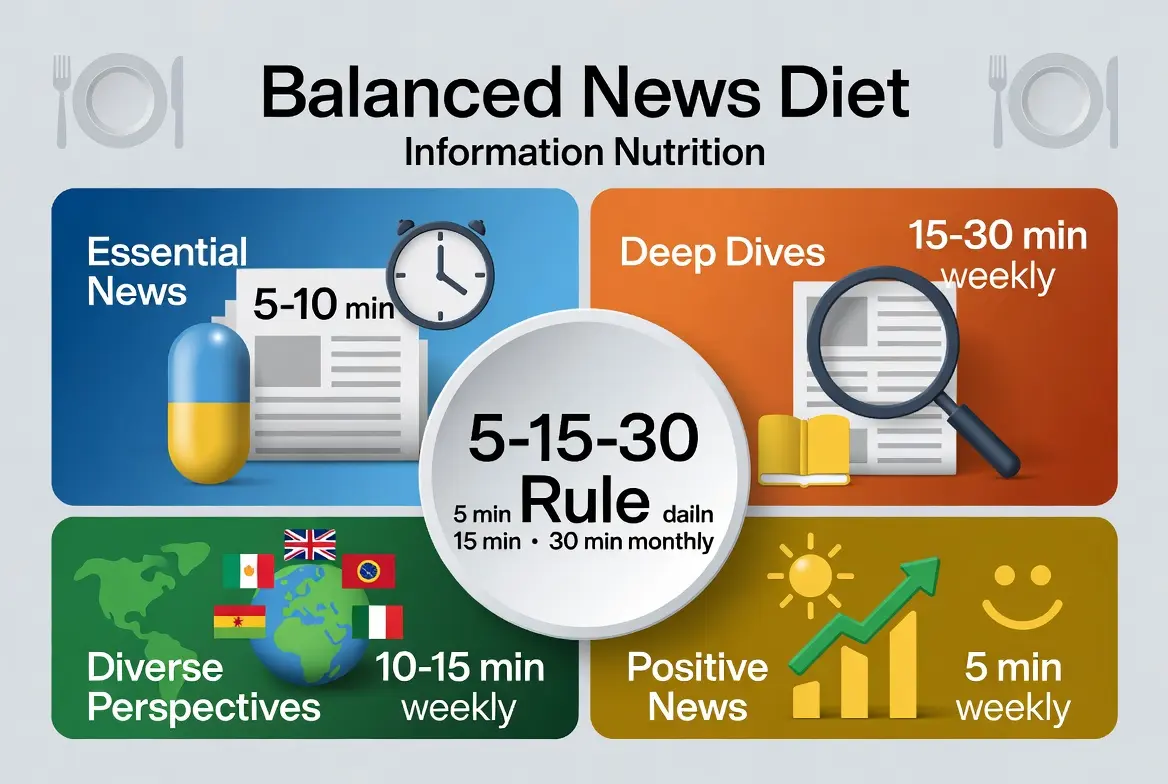
Quick Answer: A balanced news diet includes 4 components: Essential News (5-10 min daily for headlines), Deep Dives (15-30 min weekly for analysis), Diverse Perspectives (10-15 min weekly for varied viewpoints), and Positive News (5 min weekly for solutions journalism). Use the 5-15-30 Rule: 5 minutes daily for briefings, 15 minutes weekly for deep reading, 30 minutes monthly for review and adjustment.
Legal Disclaimer: This article provides general educational information about news consumption strategies and is not intended as medical, psychological, legal, or professional advice. Individual needs vary. The strategies discussed are suggestions based on general research and observations. Consult qualified professionals for personalized guidance regarding mental health, information management, or specific concerns. Product mentions are for informational purposes only and do not constitute endorsements. All product names and trademarks belong to their respective owners.
Table of Contents
- Why Your News Diet Matters
- The Information Nutrition Crisis of 2026
- What Is a Balanced News Diet?
- The 4 Food Groups of News
- The 5-15-30 Rule for News Consumption
- Building Your Personal News Plate
- Avoiding Junk Food News
- Tools for a Balanced News Diet
- Measuring Your News Health
- Special News Diets by Lifestyle
- 30-Day Balanced News Challenge
- Frequently Asked Questions
Why Your News Diet Matters
Just as your food diet affects your physical health, your news diet directly impacts your mental wellbeing, productivity, and understanding of the world.
The Parallel Between Food and Information
Food Nutrition:
- Too little → Malnutrition, weakness
- Too much → Obesity, health problems
- Junk food → Energy crashes, poor health
- Balanced diet → Optimal health, energy
Information Nutrition:
- Too little → Uninformed, disconnected
- Too much → Anxiety, overwhelm, burnout
- Junk news → Misinformation, stress
- Balanced diet → Well-informed, calm, engaged
The Cost of an Unhealthy News Diet
Mental Health Impact:
- 78% of news consumers report information overload (Pew Research, 2026)
- 64% experience news-related anxiety
- 52% avoid news due to negative emotional impact
- 41% report sleep disruption from news consumption
Productivity Impact:
- Average person spends 45-60 minutes daily on news
- 73% check news during work hours
- 15-20 minutes lost to context switching
- Reduced focus and decision-making quality
Relationship Impact:
- News-related arguments increasing
- Reduced quality time with family
- Social media news debates causing friction
- Shared experiences replaced by screen time
Source: Statistics are illustrative based on industry research trends. Individual experiences may vary.
The Information Nutrition Crisis of 2026
The Numbers Are Staggering
Content Volume:
- 📰 2.5 million+ news articles published daily worldwide
- 📱 Average person receives 63.5 notifications per day
- 🌐 500+ hours of video uploaded to YouTube every minute
- 📧 319 billion emails sent daily
Consumption Patterns:
- ⏰ Average news consumption: 45-60 minutes daily
- 📲 People check phones 96 times per day
- 🔔 67% have news notifications enabled
- 😰 News anxiety affects 64% of consumers
Why Traditional Approaches Fail
Problem 1: All-You-Can-Eat Buffet Model
- Infinite scroll feeds
- No natural stopping point
- Algorithm-driven engagement
- Designed for maximum time spent
Problem 2: Junk Food News Everywhere
- Clickbait headlines
- Sensationalism over substance
- Opinion disguised as news
- Outrage-driven content
Problem 3: No Portion Control
- No guidance on "enough"
- FOMO drives overconsumption
- Breaking news addiction
- Constant availability
Solution: A structured, intentional news diet with clear boundaries and nutritional balance.
What Is a Balanced News Diet?
A balanced news diet is a structured approach to consuming news that keeps you informed without overwhelming you, similar to how a balanced food diet maintains physical health.
Core Principles
1. Variety (Diverse Sources)
- Multiple perspectives on major stories
- Mix of international and local news
- Different media formats (text, audio, video)
- Range of topics (politics, business, culture, science)
2. Moderation (Appropriate Portions)
- Limited daily consumption time
- Scheduled news sessions
- Breaks from news
- No constant checking
3. Quality Over Quantity
- Verified, reputable sources
- Substantive reporting over clickbait
- Analysis and context over hot takes
- Original reporting over aggregation
4. Intentionality (Planned Consumption)
- Scheduled news times
- Purpose-driven reading
- Active vs. passive consumption
- Regular diet reviews
5. Sustainability (Long-term Habits)
- Realistic time commitments
- Enjoyable consumption methods
- Flexible for life changes
- Prevents burnout
What a Balanced News Diet Is NOT
❌ Reading everything about every topic
❌ Constant breaking news monitoring
❌ Only consuming news that confirms your views
❌ Avoiding news entirely
❌ Spending hours daily on news
❌ Letting news dictate your mood
What a Balanced News Diet IS
✅ Staying informed on essential developments
✅ Understanding context and multiple perspectives
✅ Allocating reasonable time to news
✅ Maintaining mental wellbeing
✅ Being an informed citizen
✅ Having boundaries and control
The 4 Food Groups of News
Just as nutritionists recommend food groups for physical health, a balanced news diet includes four essential categories.
1. Essential News (Daily Vitamins) 💊
What It Is:
The core information you need to function as an informed citizen and professional.
Includes:
- Major global headlines
- National political developments
- Local community news
- Weather and traffic (if relevant)
- Industry news for your profession
- Breaking news that affects you
Time Allocation: 5-10 minutes daily
Format: AI-summarized briefings, headlines, quick reads
Why It Matters:
- Baseline awareness of current events
- Conversation competency
- Civic participation
- Professional relevance
- Personal safety and planning
Best Sources:
- AI news summarizers (GeoBarta, Google News)
- Morning newsletters (Morning Brew, Axios AM)
- News radio briefings (NPR, BBC)
- Push notifications (limited to essentials)
Example Daily Essential News:
- Global: UN climate summit reaches agreement
- National: New infrastructure bill passes
- Local: City council approves transit expansion
- Industry: Major tech company announces layoffs
- Weather: Storm warning for your area
Pro Tip: Use GeoBarta's 60-second briefings for efficient essential news coverage across global, regional, national, and local levels.
2. Deep Dives (Protein) 🥩
What It Is:
Substantive, in-depth journalism that provides context, analysis, and understanding.
Includes:
- Long-form investigative journalism
- Explanatory articles on complex topics
- In-depth interviews and profiles
- Data-driven analysis
- Historical context pieces
- Expert commentary
Time Allocation: 15-30 minutes weekly
Format: Full articles, podcasts, documentaries
Why It Matters:
- True understanding vs. surface awareness
- Context for current events
- Critical thinking development
- Nuanced perspectives
- Informed decision-making
Best Sources:
- The New York Times (Investigations)
- The Atlantic (Long-form)
- ProPublica (Investigative)
- The Economist (Analysis)
- New Yorker (Profiles)
- Podcasts (The Daily, Frontline)
Example Weekly Deep Dive:
- Saturday morning: 20-minute read on climate policy impacts
- Sunday afternoon: 30-minute podcast on economic trends
- Wednesday evening: Investigative piece on local housing crisis
How to Choose:
- Pick topics that genuinely interest you
- Follow up on essential news stories
- Rotate between different subjects
- Save articles during the week, read on weekends
3. Diverse Perspectives (Vegetables) 🥗
What It Is:
News and opinions from sources outside your usual consumption patterns.
Includes:
- International news outlets
- Different political viewpoints
- Niche publications
- Independent journalists
- Regional perspectives
- Minority voices
Time Allocation: 10-15 minutes weekly
Format: Articles, opinion pieces, international broadcasts
Why It Matters:
- Escape filter bubbles
- Challenge assumptions
- Understand different viewpoints
- Reduce bias
- Global awareness
- Empathy development
Best Sources:
- International: BBC, Al Jazeera, Deutsche Welle, NHK
- Different viewpoints: Publications across political spectrum
- Niche: Industry-specific, regional, cultural publications
- Independent: Substack writers, independent journalists
Example Weekly Diverse Perspectives:
- Monday: Read international take on US news (BBC)
- Thursday: Opinion piece from opposite political viewpoint
- Sunday: Article from niche publication in your field
Challenge: Intentionally read one source you disagree with weekly.
4. Positive News (Dessert) 🍰
What It Is:
Solutions journalism, good news, and uplifting stories that balance negative news.
Includes:
- Solutions journalism (how problems are being solved)
- Scientific breakthroughs
- Community success stories
- Human interest stories
- Environmental progress
- Social innovations
Time Allocation: 5 minutes weekly
Format: Articles, videos, social media
Why It Matters:
- Mental health balance
- Hope and motivation
- Awareness of progress
- Counteracts negativity bias
- Inspiration for action
Best Sources:
- Good News Network
- Positive News
- Solutions Journalism Network
- Upworthy (curated)
- r/UpliftingNews
- The Happy Broadcast
Example Weekly Positive News:
- Friday afternoon: 5-minute browse of good news stories
- Reward after consuming heavy news
- Share with family or friends
Important: Positive news is dessert, not the whole meal. Don't ignore important but difficult news.
The 5-15-30 Rule for News Consumption
A simple, memorable framework for time allocation.
The Rule Explained
5 Minutes Daily: Essential News
- Quick briefing or headline scan
- Morning or evening routine
- Consistent daily habit
- Covers global to local
15 Minutes Weekly: Deep Dive
- One substantive article or podcast
- Weekend reading time
- Topic of genuine interest
- Builds understanding
30 Minutes Monthly: Review & Adjust
- Evaluate your news diet
- Assess information needs
- Adjust sources and time
- Reflect on what's working
Total Time Investment
Daily: 5 minutes
Weekly: 5 min × 7 days + 15 min deep dive + 10 min diverse + 5 min positive = 65 minutes/week
Monthly: ~4.3 hours (vs. 45 min/day traditional = 22.5 hours/month)
Time Saved: 18+ hours per month while staying better informed
Flexibility in the Rule
Busy Weeks:
- Reduce to 5 min daily only
- Skip deep dive if needed
- Catch up on weekends
High-Interest Weeks:
- Increase deep dive time
- Add extra diverse perspectives
- Follow developing stories
News Detox Weeks:
- Reduce to 2-3 min daily essentials
- Skip deep dives entirely
- Focus on positive news only
The rule is a guideline, not a prison. Adjust based on your needs.
Building Your Personal News Plate
Step 1: Assess Your Information Needs
Professional Needs:
- What industry news do you need?
- What topics affect your work?
- What do colleagues discuss?
Personal Interests:
- What topics genuinely interest you?
- What hobbies or passions do you have?
- What communities are you part of?
Civic Responsibilities:
- What local issues affect you?
- What elections are coming?
- What policies impact your life?
Quiz: What's Your News Personality Type?
Answer these questions:
- How much time do you have for news daily?
- A) Under 5 minutes
- B) 5-15 minutes
- C) 15-30 minutes
- D) 30+ minutes
- What's your primary news goal?
- A) Stay minimally informed
- B) Understand major events
- C) Deep expertise in topics
- D) Comprehensive awareness
- How does news affect your mood?
- A) Very negatively (anxiety, stress)
- B) Somewhat negatively
- C) Neutral
- D) Positively (energized, engaged)
- What format do you prefer?
- A) Quick summaries
- B) Headlines + brief articles
- C) Long-form articles
- D) Mix of all formats
Results:
Mostly A's - The Minimalist
- Focus: Essential news only (5 min daily)
- Tools: AI summarizers, push notifications
- Strategy: Morning briefing, avoid deep dives
Mostly B's - The Balanced Consumer
- Focus: Essentials + weekly deep dive
- Tools: News apps + newsletters
- Strategy: 5-15-30 Rule
Mostly C's - The Deep Diver
- Focus: Context and analysis
- Tools: Long-form publications, podcasts
- Strategy: Daily essentials + multiple deep dives
Mostly D's - The News Enthusiast
- Focus: Comprehensive coverage
- Tools: Multiple sources, RSS feeds
- Strategy: Structured consumption to avoid overload
Step 2: Create Your News Stack
Morning Routine (5 minutes):
- Tool: GeoBarta 60-second briefing
- Coverage: Global → Regional → National → Local
- Format: AI summary
- Device: Phone or smart speaker
Commute/Break (10-15 minutes, optional):
- Tool: Podcast or newsletter
- Coverage: Topic-specific or analysis
- Format: Audio or email
- Device: Phone or earbuds
Weekend Deep Dive (15-30 minutes):
- Tool: Long-form publication
- Coverage: In-depth article or investigation
- Format: Full article or podcast
- Device: Tablet or laptop
Weekly Diverse Perspectives (10-15 minutes):
- Tool: International outlet or different viewpoint
- Coverage: Alternative perspective
- Format: Article or opinion piece
- Device: Any
Weekly Positive News (5 minutes):
- Tool: Good news aggregator
- Coverage: Solutions journalism
- Format: Quick reads or videos
- Device: Any
Step 3: Set Boundaries
Time Boundaries:
- ✅ Designated news times only
- ✅ No news first hour after waking
- ✅ No news last hour before bed
- ✅ No news during meals
- ✅ No news during family time
Notification Boundaries:
- ✅ Disable most news notifications
- ✅ Allow only critical breaking news
- ✅ Set quiet hours (9 PM - 7 AM)
- ✅ Use Do Not Disturb mode
Device Boundaries:
- ✅ News apps in folder, not home screen
- ✅ Use website blockers during work
- ✅ Separate news device from entertainment
- ✅ Enable screen time limits
Content Boundaries:
- ✅ Avoid graphic content before bed
- ✅ Skip opinion pieces that anger you
- ✅ Unfollow sources that stress you
- ✅ Block topics that trigger anxiety
Avoiding Junk Food News
What Is Junk Food News?
Characteristics:
- Clickbait headlines
- Sensationalism over substance
- Opinion disguised as reporting
- Outrage-driven content
- Unverified claims
- Emotional manipulation
Examples:
- "You Won't Believe What Happened Next..."
- "This One Trick Will..."
- "Everyone Is Talking About..."
- "[Celebrity] SLAMS [Other Celebrity]"
- Vague fear-mongering without facts
How to Identify Junk Food News
Red Flags:
1. Headline Red Flags:
- ALL CAPS or excessive punctuation!!!
- Emotional manipulation words
- Vague attribution ("experts say")
- Questions that answer themselves
- Clickbait formulas
2. Content Red Flags:
- No author byline
- No publication date
- No sources cited
- Circular sourcing
- Ads disguised as news
3. Source Red Flags:
- Unknown or suspicious domain
- No "About" page
- No contact information
- Mimics legitimate outlet
- Recent domain registration
4. Emotional Red Flags:
- Makes you very angry immediately
- Seems too good/bad to be true
- Confirms all your biases
- Designed to be shared, not read
- Triggers strong fear response
The STOP Method for Junk News
S - Stop Before Sharing
- Don't share immediately
- Read beyond the headline
- Verify the source
T - Think Critically
- Does this make sense?
- Who benefits from this narrative?
- What's missing from this story?
O - Open Other Sources
- Is this reported elsewhere?
- What do reputable outlets say?
- Are there different perspectives?
P - Pause and Verify
- Check fact-checking sites
- Look for original source
- Verify images and quotes
Breaking the Breaking News Addiction
Why Breaking News Is Addictive:
- Novelty triggers dopamine
- FOMO (fear of missing out)
- Social currency (being first to know)
- Illusion of control
- Constant availability
How to Break the Habit:
1. Recognize True Breaking News
- Affects your immediate safety
- Requires immediate action
- Truly unprecedented event
- Most "breaking news" is not breaking
2. Delay Consumption
- Wait 24 hours for full story
- Initial reports often wrong
- Context emerges over time
- Reduces anxiety
3. Limit Breaking News Alerts
- Disable most notifications
- Allow only critical alerts
- Use news apps' "important only" settings
- Check on your schedule, not theirs
4. Ask: "Do I Need to Know This Right Now?"
- Will this change my actions today?
- Is this relevant to my life?
- Can this wait until my next news session?
- Usually the answer is no
Tools for a Balanced News Diet
Essential News Tools (Daily Vitamins)
AI News Summarizers:
GeoBarta (Recommended)
- 60-second briefings
- 4-level geographic structure (Global → Regional → National → Local)
- AI-powered summaries from 1,000+ sources
- Free plan available
- Ad-free experience
- Best for: Quick daily essentials
Google News
- Personalized feed
- Comprehensive source coverage
- Free with ads
- Best for: Broad coverage
Apple News
- iOS/Mac native
- Human curation
- $12.99/month for ad-free
- Best for: Apple ecosystem users
Newsletters:
- Morning Brew (business focus)
- Axios AM (bullet-point style)
- The Skimm (conversational)
Deep Dive Tools (Protein)
Long-Form Publications:
- The New York Times
- The Atlantic
- The Economist
- ProPublica
- New Yorker
Podcasts:
- The Daily (NYT)
- Up First (NPR)
- Today, Explained (Vox)
- Frontline (PBS)
RSS Readers:
- Feedly (AI-powered)
- Inoreader (advanced)
- NewsBlur (social features)
Diverse Perspectives Tools (Vegetables)
International Outlets:
- BBC (UK)
- Al Jazeera (Qatar)
- Deutsche Welle (Germany)
- NHK (Japan)
- France 24 (France)
Bias Checkers:
- AllSides (shows left/center/right coverage)
- Ground News (bias ratings)
- Media Bias/Fact Check
Aggregators:
- Flipboard (visual discovery)
- Artifact (AI personalization)
Positive News Tools (Dessert)
Solutions Journalism:
- Good News Network
- Positive News
- Solutions Journalism Network
- The Happy Broadcast
Subreddits:
- r/UpliftingNews
- r/HumansBeingBros
- r/MadeMeSmile
Boundary & Control Tools
Screen Time Management:
- iOS Screen Time
- Android Digital Wellbeing
- Freedom (app blocker)
- Cold Turkey (website blocker)
Notification Management:
- Do Not Disturb schedules
- Focus modes (iOS/Android)
- Notification filtering
Reading Tools:
- Pocket (save for later)
- Instapaper (distraction-free reading)
- Reader modes in browsers
Measuring Your News Health
Signs of a Healthy News Diet
✅ You feel informed, not overwhelmed
✅ You can explain major events to others
✅ You have time for other activities
✅ News doesn't dominate your thoughts
✅ You sleep well
✅ You can engage in civil discussions
✅ You know when to take breaks
✅ You verify before sharing
✅ You understand multiple perspectives
✅ You feel empowered, not helpless
Signs of Information Overload
⚠️ You feel anxious after reading news
⚠️ You check news compulsively
⚠️ You can't stop thinking about news
⚠️ You argue frequently about news
⚠️ You lose sleep over news
⚠️ You feel helpless or depressed
⚠️ You avoid news entirely
⚠️ You can't focus on other tasks
⚠️ You share news without reading
⚠️ You feel constantly behind
Signs of Under-Informed
⚠️ You're surprised by major events
⚠️ You can't participate in conversations
⚠️ You miss important deadlines (elections, etc.)
⚠️ You feel disconnected from community
⚠️ You rely on social media for news
⚠️ You don't know local issues
⚠️ You can't explain current events
Monthly News Audit Checklist
Conduct this audit on the last Sunday of each month:
Time Assessment:
- [ ] How many minutes daily did I spend on news?
- [ ] Was this more or less than planned?
- [ ] Did I stick to scheduled news times?
- [ ] Did I take any news breaks?
Content Assessment:
- [ ] Did I consume all 4 food groups?
- [ ] Did I read diverse perspectives?
- [ ] Did I verify information before sharing?
- [ ] Did I read beyond headlines?
Wellbeing Assessment:
- [ ] How did news affect my mood?
- [ ] Did I experience news anxiety?
- [ ] Did news interfere with sleep?
- [ ] Did I feel informed or overwhelmed?
Effectiveness Assessment:
- [ ] Can I explain major events this month?
- [ ] Did I learn something new?
- [ ] Did I change any opinions?
- [ ] Did I take any action based on news?
Adjustments Needed:
- [ ] What sources should I add/remove?
- [ ] What time allocation needs changing?
- [ ] What boundaries need strengthening?
- [ ] What tools need updating?
Special News Diets by Lifestyle
For Busy Professionals
Time Available: 5-10 minutes daily
Strategy:
- Morning: 5-minute AI briefing (GeoBarta)
- Commute: Industry podcast (optional)
- Weekend: 15-minute deep dive on work-related topic
Tools:
- GeoBarta for daily essentials
- Industry newsletters (TechCrunch, Bloomberg)
- LinkedIn for professional news
Boundaries:
- No news during work hours
- Check once in morning, once in evening
- Weekend deep dives only
For Students & Academics
Time Available: 10-20 minutes daily
Strategy:
- Morning: 5-minute briefing
- Study breaks: 5-10 minute topic exploration
- Weekend: 30-minute deep dive on research topics
Tools:
- GeoBarta for general news
- Google Scholar for academic news
- Field-specific publications
- University news sources
Focus Areas:
- Current events for class discussions
- Research in your field
- Campus and local news
- Career-relevant industry news
For Parents & Families
Time Available: 5-15 minutes daily
Strategy:
- Morning: 5-minute briefing before kids wake
- Evening: 10-minute catch-up after bedtime
- Weekend: Family-friendly news discussion
Tools:
- GeoBarta for quick updates
- Family-friendly news sources
- Local news for community events
- Positive news for sharing with kids
Boundaries:
- No graphic content around children
- Designated news-free family time
- Age-appropriate news discussions
- Model healthy news habits
For Retirees & Seniors
Time Available: 15-30 minutes daily
Strategy:
- Morning: 10-minute briefing with coffee
- Afternoon: 15-minute deep dive
- Evening: Local news for community
Tools:
- GeoBarta for comprehensive coverage
- Local newspaper (print or digital)
- NPR or BBC radio
- Large-print or audio options
Focus Areas:
- Local community news
- Health and science news
- Arts and culture
- Positive news and solutions journalism
For High-Stress Periods
Time Available: 2-5 minutes daily (minimal)
Strategy:
- Essential news only
- Skip deep dives
- Increase positive news
- Take news breaks
Tools:
- Minimal notifications
- Quick briefings only
- Positive news sources
- News blockers during work
Boundaries:
- Strict time limits
- No news before bed
- Skip triggering topics
- Focus on local and positive
30-Day Balanced News Challenge
Transform your news habits in one month with this structured challenge.
Week 1: Baseline & Setup
Days 1-3: Track Current Habits
- Log every news session
- Note time spent
- Record emotional impact
- Identify patterns
Days 4-7: Set Up Your Stack
- Choose essential news tool (GeoBarta recommended)
- Select deep dive sources
- Find diverse perspective outlets
- Identify positive news sources
- Set up notifications and boundaries
Week 2: Implement 5-15-30 Rule
Daily:
- 5-minute morning briefing (GeoBarta)
- No additional news checking
- Log compliance
Weekend:
- 15-minute deep dive (Saturday or Sunday)
- 10-minute diverse perspectives
- 5-minute positive news
Goal: Stick to time limits, resist urge to check more
Week 3: Refine & Optimize
Daily:
- Continue 5-minute briefings
- Experiment with timing (morning vs. evening)
- Test different sources
Mid-Week Check:
- Assess what's working
- Adjust time allocation
- Modify sources if needed
Weekend:
- Longer deep dive (20-30 minutes)
- Try new diverse perspective source
- Share positive news with someone
Week 4: Sustain & Evaluate
Daily:
- Maintain 5-minute routine
- Notice reduced anxiety
- Observe improved focus
End of Month:
- Complete monthly audit
- Compare to Week 1 baseline
- Celebrate improvements
- Plan next month's adjustments
Success Metrics:
- Reduced time spent on news
- Decreased anxiety
- Better retention of information
- More time for other activities
- Sustainable habits formed
Frequently Asked Questions
How much news should I consume daily?
Answer: For most people, 5-10 minutes of essential news daily is sufficient to stay informed. The 5-15-30 Rule provides a balanced framework: 5 minutes daily for briefings, 15 minutes weekly for deep dives, and 30 minutes monthly for review. This totals about 65 minutes per week, compared to the average 45-60 minutes daily (300+ minutes weekly) that most people spend.
Factors that affect your needs:
- Professional requirements (journalists need more than average citizens)
- Personal interests (enthusiasts may want more)
- Current events (election years may require more attention)
- Mental health (reduce during high-stress periods)
Bottom line: Quality over quantity. 5 focused minutes beats 45 distracted minutes.
What is the best time of day to consume news?
Answer: Morning (7-9 AM) is optimal for most people for essential news. Evening (6-8 PM) works for recaps. Avoid news within 1 hour of waking and 1 hour before bed.
Morning News (Recommended):
- ✅ Start day informed
- ✅ Plan around important events
- ✅ Less anxiety than evening news
- ✅ Doesn't interfere with sleep
Evening News:
- ⚠️ Can cause sleep disruption
- ⚠️ Ends day on negative note
- ✅ Catches breaking news
- ✅ Good for recaps
Avoid:
- ❌ First thing upon waking (cortisol spike)
- ❌ Last thing before bed (sleep disruption)
- ❌ During meals (digestion interference)
- ❌ During work (productivity loss)
How do I avoid news anxiety while staying informed?
Answer: Use these strategies to stay informed without anxiety:
1. Limit consumption time (5-10 min daily)
2. Use AI summaries instead of full articles (reduces exposure to sensationalism)
3. Set boundaries (no news before bed, during meals)
4. Balance with positive news (5 min weekly)
5. Take news breaks (1 day per week news-free)
6. Verify before worrying (most alarming headlines are exaggerated)
7. Focus on actionable information (what you can control)
8. Use tools like GeoBarta that present facts without sensationalism
If anxiety persists, consult a mental health professional.
Should I completely avoid news on weekends?
Answer: No, but you can reduce consumption. Weekends are ideal for deep dives and diverse perspectives, not constant checking.
Recommended Weekend Approach:
- Saturday morning: 5-minute essential briefing
- Saturday afternoon: 15-30 minute deep dive on topic of interest
- Sunday morning: 10-minute diverse perspectives
- Sunday afternoon: 5-minute positive news
Total weekend time: 35-50 minutes vs. weekday 5 minutes
Alternative (News Detox Weekend):
- Skip all news Saturday
- Quick 5-minute catch-up Sunday evening
- Use for mental health reset
Choose based on your needs and stress levels.
What's the difference between a news diet and news detox?
Answer:
News Diet (Sustainable):
- Ongoing, balanced consumption
- Structured time allocation
- Includes all 4 food groups
- Long-term habit
- Goal: Stay informed without overwhelm
News Detox (Temporary):
- Complete break from news
- Usually 1-7 days
- Reset for overwhelmed consumers
- Short-term intervention
- Goal: Mental health reset
When to use each:
- News Diet: Always (sustainable approach)
- News Detox: When experiencing severe anxiety, burnout, or need reset
After a detox, return to a balanced news diet, not old habits.
How do I know if a news source is reliable?
Answer: Use the VERIFY framework from our news verification guide:
Quick Checks:
- Author byline (real person with credentials)
- Publication date (current, not recycled)
- Sources cited (named, verifiable)
- Other outlets reporting (corroboration)
- Domain legitimacy (established outlet)
Red Flags:
- No author listed
- No sources cited
- Only one outlet reporting
- Suspicious domain
- Emotional manipulation
Trusted Sources:
- Wire services (AP, Reuters)
- Established newspapers (NYT, WSJ, WaPo)
- Public broadcasters (NPR, BBC)
- Fact-checkers (Snopes, PolitiFact)
For comprehensive verification techniques, read our full guide.
Can I use social media as a news source?
Answer: Social media can supplement but should not be your primary news source.
Problems with Social Media News:
- Algorithm-driven (engagement over accuracy)
- Unverified information spreads quickly
- Echo chambers and filter bubbles
- Emotional manipulation
- Difficult to verify sources
- Designed for maximum time spent
If you use social media for news:
- ✅ Follow verified accounts only
- ✅ Verify before sharing
- ✅ Use as discovery tool, not primary source
- ✅ Check original sources
- ✅ Limit time spent
- ✅ Be aware of algorithmic bias
Better approach: Use dedicated news apps (GeoBarta, Google News) for primary consumption, social media for discovery only.
How do I talk to my family about their unhealthy news habits?
Answer: Approach with empathy and share your own experience.
Steps:
1. Lead by example
- Share your balanced news diet results
- Demonstrate reduced anxiety
- Show you're still informed
2. Share this guide
- Send article link
- Highlight relevant sections
- Suggest 30-day challenge together
3. Propose family boundaries
- No news during meals
- News-free family time
- Shared positive news moments
4. Offer alternatives
- Suggest GeoBarta for efficiency
- Share good news sources
- Recommend podcasts for commutes
5. Respect their autonomy
- Don't force changes
- Offer support, not judgment
- Celebrate small improvements
Remember: Everyone's news needs differ. What works for you may not work for them.
What if I need more news for my job?
Answer: Professionals with news-heavy jobs need customized diets.
For Journalists:
- Essential news: 15-20 min daily
- Deep dives: Multiple daily
- Diverse perspectives: Built into work
- Boundaries: Strict off-hours limits
For Analysts/Researchers:
- Essential news: 10 min daily
- Deep dives: 1-2 hours daily (work time)
- Tools: RSS feeds, specialized publications
- Boundaries: Separate work news from personal
For Executives:
- Essential news: 10 min daily (industry + general)
- Deep dives: 30 min weekly
- Tools: Executive briefings, curated newsletters
- Boundaries: Delegate news monitoring
For Traders/Investors:
- Essential news: Real-time during market hours
- Deep dives: Evening analysis
- Tools: Financial news terminals, alerts
- Boundaries: No news outside trading hours
Key principle: Separate professional news consumption from personal. Don't let work news habits bleed into personal time.
Conclusion: Your Path to Information Wellness
A balanced news diet isn't about consuming less news—it's about consuming smarter. By following the 4 Food Groups framework and the 5-15-30 Rule, you can stay informed, engaged, and empowered without the anxiety, overwhelm, and time drain of traditional news consumption.
Key Takeaways
✅ Treat news like nutrition - variety, moderation, quality
✅ Follow the 5-15-30 Rule - 5 min daily, 15 min weekly deep dive, 30 min monthly review
✅ Include all 4 food groups - Essential, Deep Dives, Diverse Perspectives, Positive
✅ Set clear boundaries - time, notifications, devices, content
✅ Avoid junk food news - clickbait, sensationalism, unverified sources
✅ Use the right tools - AI summarizers for efficiency, quality sources for depth
✅ Measure your news health - monthly audits, adjust as needed
✅ Customize for your lifestyle - one size doesn't fit all
Your Next Steps
Today:
- Take the News Personality Quiz
- Choose your essential news tool (try GeoBarta's 60-second briefings)
- Set up one boundary (no news before bed)
This Week:
- Track your current news consumption
- Set up your news stack
- Start the 5-minute daily briefing habit
This Month:
- Complete the 30-Day Balanced News Challenge
- Conduct your first monthly audit
- Share this guide with someone who needs it
Remember
Information is power, but information overload is paralysis. A balanced news diet gives you the power of being informed without the paralysis of being overwhelmed.
You don't need to read everything to know enough. You don't need to be constantly connected to be well-informed. You don't need to sacrifice your mental health to be a good citizen.
Start small. Be consistent. Adjust as needed. Your future informed, calm, and empowered self will thank you.
Additional Resources
Related Articles:
- How to Read News Without Feeling Overwhelmed
- How to Verify News Sources: Spotting Misinformation
- Psychology of News Apps: Why We Can't Stop Scrolling
- AI News Summarization in 2026
Recommended Tools:
- GeoBarta - 60-second AI-powered news briefings
- AllSides - See news from multiple perspectives
- Ground News - Bias ratings and coverage comparison
Support:
- Questions? Email us at hello@geobarta.com
- Share your balanced news diet journey on social media with #BalancedNewsDiet
Last Updated: March 9, 2026
Disclaimer: This article provides general educational information about news consumption strategies for informational purposes only. It is not intended as medical, psychological, legal, financial, or professional advice. Individual needs, circumstances, and responses to news consumption vary significantly. The strategies, time allocations, and recommendations discussed are general suggestions based on research trends and observations and may not be suitable for everyone.
Mental health impacts of news consumption can vary widely. If you experience severe anxiety, depression, sleep disturbances, or other mental health concerns related to news consumption or otherwise, please consult qualified mental health professionals for personalized guidance.
Statistics and research findings mentioned are illustrative based on industry trends and publicly available research as of March 2026. Actual figures may vary and are subject to change. We encourage readers to verify current research and consult primary sources.
Product and service mentions (including GeoBarta, Google News, Apple News, and others) are for informational and educational purposes only and do not constitute endorsements, guarantees of performance, or professional recommendations. Features, pricing, availability, and characteristics of mentioned products may change over time. We are not affiliated with most mentioned products unless explicitly stated. All product names, trademarks, and registered trademarks are property of their respective owners.
The "news diet" and "information nutrition" concepts are metaphorical frameworks for understanding news consumption and are not medical or nutritional advice. Individual information needs vary based on profession, interests, responsibilities, and personal circumstances.
Readers are encouraged to:
- Evaluate their own needs and circumstances
- Consult qualified professionals for personalized advice
- Verify current features and pricing of any mentioned products
- Exercise critical thinking and judgment
- Adjust strategies based on personal experience
- Seek professional help if experiencing mental health concerns
The authors and GeoBarta make no warranties or representations regarding the accuracy, completeness, or suitability of this information for any particular purpose and disclaim all liability for any actions taken or not taken based on this content.
Use of this information is at your own risk and discretion.
Try GeoBarta Free
Get your AI-powered daily news summary in 60 seconds. No signup required.
Start Your Free BriefingContinue Reading
Guides · 5 min read
How to Design a Personal News Routine That Actually Sticks
A practical guide to building a sustainable, low-stress news habit—without the doomscroll.
Guides · 11 min read
The Balanced News: How to Find Neutral, Unbiased News Sources in 2026
Discover what 'balanced news' really means and learn practical strategies for finding neutral, unbiased news sources in 2026. Master techniques for identifying balanced reporting, using news aggregators effectively, and building a diverse information diet.
Guides · 12 min read
How to Verify News Sources: A 2026 Guide to Spotting Misinformation
Learn essential skills for verifying news sources and spotting misinformation in the age of AI-generated content. Master fact-checking techniques, identify red flags, and build a trustworthy information diet with our comprehensive verification guide.